


Catholic Medical Quarterly Vol 76 (4) November 2026
Book Review
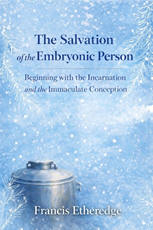
The Salvation of the Embryonic Person: Beginning with
the Incarnation and the Immaculate Conception
by Francis Etheredge En Route Books and Media
Reviewed b Dr Pravin Thevasathan
 I
have been sent an advanced copy of this excellent book to review. Life
begins at conception. That is a simple scientific fact. So, what is the
fate of embryonic human life generated as a result of In Vitro
Fertilisation (IVF)?
As the author notes, human rights are widely available, but not for
these tiny little human beings. The author persuasively argues that these
cryopreserved human embryos desrve to be granted human rights.
What
the author does somewhat uniquely is to examine the issue in the light of
the Incarnation. Issues surrounding IVF are ethical, but they are also
theological. When we reflect on God becoming Incarnate in the womb of
Mary, we have theological reasons to respect the human embryo.
Is the human embryo a potential human being or a human being with potential? Even to ask this question is insufficient. As the author persuasively argues, from the moment of conception, the human embryo is a human being with intrinsic dignity, not a being with potential, and certainly not a potential being. In the light of the Incarnation, a human being can never be considered morally negligible at any stage from conception onwards. It is someone, not something.
The author notes clearly that IVF is morally wrong. But what moral responsibility do we have towards the human embryos generated? The author argues in favour of embryo adoption. Embryo adoption does not make legitimate the evil act of IVF. Adoption is intended as protecting the right to life. A moral philosopher I knew and respect came to a different conclusion, arguing against embryo adoption. The debate will continue. But this book helps us to deeply reflect on this important issue.