


Catholic Medical Quarterly Vol 76 (2) May 2026
Saint Elizabeth of Hungary in Thuringia
Robert Hardie
“Come and spend the weekend with us in Munich (after we’ve been skiing)” Clare’s cousin asked on the magic Facetime. Norwich has a tiny airport and very easy access to Schiphol (Amsterdam), and with a car hired from Schiphol Airport, directly en route from Amsterdam to Munich is Thuringia where St Elizabeth was the Landgravine (Duchess equivalent) of the principality in the early 1200s. We accepted!
Because we travelled North to South, our visits to places associated with St Elizabeth go chronologically backwards, starting where she died in Marburg (actually in Hesse, but this had been annexed to Thuringia in the 13th Century) and ending in Munich where her mother, Gertrude’s, family originated (her father, Andrew II, was king of Hungary and descended from the ancient Arpad dynasty which was in turn traditionally descended from Attila the Hun).
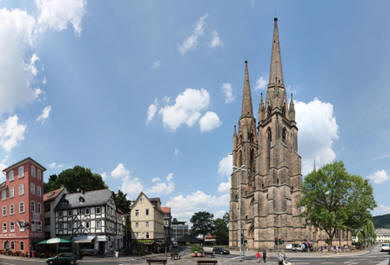 In horrendous weather (it was early March and we had wondered why we
had no choice in having winter tyres on the hire car! Snow, sleet, slush,
and spray from the endless column of lorries periodically enveloped us!)
we arrived in Marburg at 4.15 pm. Here in the Elisabethkirche, St
Elizabeth is buried. The weather in the photo is rather better than we
experienced and obviously was taken later in the year!
In horrendous weather (it was early March and we had wondered why we
had no choice in having winter tyres on the hire car! Snow, sleet, slush,
and spray from the endless column of lorries periodically enveloped us!)
we arrived in Marburg at 4.15 pm. Here in the Elisabethkirche, St
Elizabeth is buried. The weather in the photo is rather better than we
experienced and obviously was taken later in the year!
The church had closed at 4 pm! Something in me said don't worry! In the persisting rain we came across a car at the back of the church and set upon the frau driver who spoke no English (this we found is common in Thuringia which was in East Germany pre-1989), so we played dumb charades but to no avail! Her husband then emerged from a door in the back of the church and the process was repeated, again to no avail. Then a miracle! A third local emerged and locked the door.
His English was vastly better and he managed “Come back tomorrow.” I explained I am a Franciscan and have come specially here to pay my respects and will be in Nuremberg tomorrow! We have only 4 nights in Germany! He took pity on us (perhaps the rain helped!), so the door was reopened and respects were paid (to him and the wonderful church and St. Elizabeth`).
Elisabethkirche was built under the direction of Meister Konrad von Marburg next to one of Elizabeth’s hospitals. The foundation stone was laid in 1235 and on this beautiful building Cologne Cathedral was modeled. Meister Konrad was St Elizabeth’s (very tough) spiritual director. There is a masterful description by him of her holiness and death as the Second Reading in the Divine Office on her feast day - 17 November.
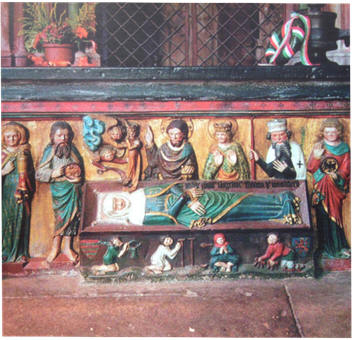 Her tomb is also very beautiful and we felt immensely moved, privileged
and grateful to have our own private viewing. Notice the pilgrims kneeling
(like me) beneath her coffin and her soul being presented to the Lord and
His Holy Mother by angels (how similar to Cardinal Newman’s Dream of
Gerontius).
Her tomb is also very beautiful and we felt immensely moved, privileged
and grateful to have our own private viewing. Notice the pilgrims kneeling
(like me) beneath her coffin and her soul being presented to the Lord and
His Holy Mother by angels (how similar to Cardinal Newman’s Dream of
Gerontius).
For all those who have her as a patron saint (Secular Franciscans and CMA members), a visit sometime in their lifetimes is a major must if at all possible!! My life is so full of her life as a result.
I was speaking to an Anglican friend recently of our experiences and he agreed that the saints INSPIRE US! How very true - similar to the Lord INSPIRING US with His Spirit, I believe they do with their spirits (or perhaps all these spirits are one in the Holy Spirit).
From Marburg we ploughed through more snow, spray and sleet for another 100km, South East, through snow laden pine forests to Eisenach in the middle of Thuringia (by now well on into the night, we hadn't totally appreciated the distance from Amsterdam!).
Another miracle (to me) - during the night the seasons changed and we
awoke to glorious sunshine in our motel on the outskirts of Eisenach, so
off we go exploring!
Eisenach is a pretty town surrounded by
beech forests and under the perpetual gaze of St Elizabeth’s castle that
perches on a precipice 1300 ft. above it.
It was in Eisenach that Johann Sebastian Bach was born and lived until the age of 10, so the Bachhaus was a must (we were initially directed to a house in the Park as I hadn't sufficiently cleared out the back of my mouth pronouncing Bachhaus while asking directions). It is utterly enchanting. There is an excellent museum and a short concert was played on period instruments. The JS Bach choccie biscuits were something to die for!
Martin Luther also lived in Eisenach and sought sanctuary in the Wartburg castle after he had incensed the Church authorities in 1521. There in a small room in the castle (still preserved) where he translated the New Testament from the original Greek into German in eleven weeks!!
The town itself is very beautiful but (needs must) is surrounded by less attractive industrial estates. There is nothing new in the interface between aesthetics and commerce. Elizabeth herself faced similar problems most of her life as did St Francis.
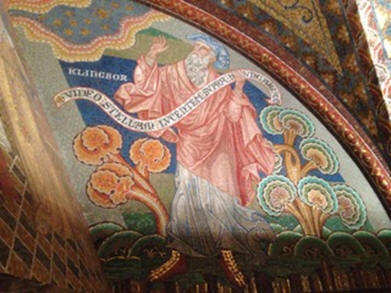 Elizabeth’s castle is (obviously) medieval and dates from 1067 and is
very much the same now as in her day. Elizabeth was born in 1207 on the
7th of the 7th!!! A truly holy date!! No wonder so much mythology as well
as factual history surrounds her life. During her childhood there, Wolfram
von Eschenbach was a guest and wrote the poem Parzifal, based on Sir
Percival and the Grail Story, which was regarded as the greatest of German
epics and very much later set to music by Richard Wagner as Parsival. In
it ‘Klingsor' takes the role of Merlin and he is seen here on one of the
unbelievably beautiful mosaic murals predicting Elizabeth’s birth.
Elizabeth’s castle is (obviously) medieval and dates from 1067 and is
very much the same now as in her day. Elizabeth was born in 1207 on the
7th of the 7th!!! A truly holy date!! No wonder so much mythology as well
as factual history surrounds her life. During her childhood there, Wolfram
von Eschenbach was a guest and wrote the poem Parzifal, based on Sir
Percival and the Grail Story, which was regarded as the greatest of German
epics and very much later set to music by Richard Wagner as Parsival. In
it ‘Klingsor' takes the role of Merlin and he is seen here on one of the
unbelievably beautiful mosaic murals predicting Elizabeth’s birth.
Elizabeth was sent to the Wartburg (it means ‘Watchtower’) from Hungary at the age of 4, betrothed to the eldest son of the Landgraf (ruler of the principality, equivalent to a Duke). She married Ludwig II, her intended’s younger brother (her intended had died before she reached puberty), in 1221. They had an exceptionally blissful marriage and were blessed with 3 children. Ludwig supported all that Elizabeth did in feeding the poor and caring for the sick. They both longed for a time when they might both be relieved of their courtly duties and follow a life of utter simplicity and service. I am sure the intense beauty of the surrounding countryside must have prompted some of these thoughts. They even planned a hundred-acre farm that they could run! Elizabeth, herself, cast off as many of the burdens of royalty as she could. There is the lovely story of how her infuriated mother-in-law led her son to see a leper that Elizabeth was caring for in her (and his) own bed! When Ludwig looked at the bed all he could see was the Lord on His Cross lying where the leper was reported to be!
Ludwig supported Elizabeth in the building of 2 hospitals, one in Eisenach and the other in Gotha (16 miles east of Eisenach). He even agreed with her when in his absence she instituted a fairer system for the poor in which they received a share of the profits from the produce of the land (rather like those working for John Lewis today). His absolute trust in her goodness and ability extended as far as granting her his ‘Faculties’ that gave her free rein in their affairs. Not surprisingly many members of her husband’s family who valued power, prestige and privilege above conscience became hostile towards them both.
The wonderful thing about Elizabeth’s system was that it worked; because by caring for the work force the work force remained in a good state of health and were more able to work the land and increase the profits! This still has to be learnt today! With the arrival of the Franciscan friars in Thuringia in 1224, Elizabeth was able to immediately identify her own developing spirituality with their teaching of poverty and service. In fact, St Francis sent her the mantle he had been was wearing for “his most humble German daughter”. She wore it whenever she asked something special from God!
Tragically Ludwig died on Crusade in 1227 and Elizabeth’s heart broke. She cried, “He is dead, dead, and the world and everything that is sweet in the world is dead to me.” Elizabeth was a widow at the age of 20!
Under the strict eye of Meister Konrad whose mediaeval mission was to help Elizabeth renounce everything except God, her progression rapidly accelerated after Ludwig’s death. She announced (against Konrad’s ruling) that she would beg from door to door as the friars did (“I will do this, for you can’t forbid me” she said to him) and on Good Friday in 1228 before some Franciscan friars and her family, she formally vowed to renounce the world and follow the evangelical counsels of poverty, chastity and obedience. The following year she was tonsured and professed as a Franciscan. She was probably the first official Secular Franciscan outside Italy (in Italy Francis had encouraged the formation of the ‘Brothers and Sisters of Penance’ as the third order after the Friars and the Poor Clares).
Also aiding her in her rejection of all things temporal were the members of her husband’s family (though they hardly had her best interests at heart) who ousted her from the Wartburg and refused her access to her own dowry castle at Marburg. Eventually her children too were removed from her as how could the family allow the heirs to the principality to live and be brought up like penniless paupers? At this moment of almost complete abandonment apart from her two lady companions, she experienced a vision of ecstatic closeness to the Lord Jesus. Why did she have to suffer so before this happened? This sometimes seems a mystery to us in of our human state, but possibly God allows humans to arrive at this moment where nothing else matters but the Lord Himself, to then realise that in the end there is only Love. “Taking pity on me, He again turned his most serene face towards me saying, ‘If you want to be with me, I will be with you.’” This is what we were all made for, absolute union with Him, for as the Psalmist says, “Those who chose other gods increase their sorrows.” (Ps 16)
As if to prove the point materially as well as spiritually, just at that crucial moment Pope Gregory IX intervened and insisted that her lands be restored to her. At last, she was free to voluntarily follow her way of poverty and service rather than having penury imposed on her. She continued to work and live in the hospital she had had built in Marburg while also begging as a Franciscan sister!
The extraordinary thing is that through all this she carved out a path that had previously been impassible for women - to act completely according to their consciences while remaining in their secular state in the world.
St Elizabeth finally died on 17 November 1231 in Marburg completely worn out by her selfless love and service to the poor and sick.
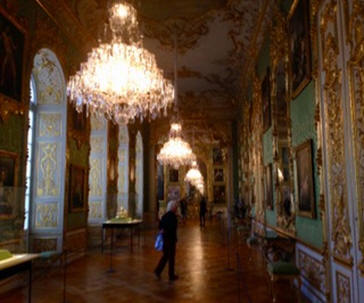 From Eisenach we drove via Nuremberg to Munich (another story!). It was
just outside Munich on the Andech Mountain that Elizabeth’s mother’s
family had their home. This was the famous the House of Andechs, a very
powerful Bavarian dynasty.
From Eisenach we drove via Nuremberg to Munich (another story!). It was
just outside Munich on the Andech Mountain that Elizabeth’s mother’s
family had their home. This was the famous the House of Andechs, a very
powerful Bavarian dynasty.
We found it fascinating to contrast Elizabeth’s life of self imposed and externally imposed poverty, with that of so many other members of her mother’s family who had basked in the excesses of opulence. Walking round the Residence (the Palace in Munich see above!) one became very aware of the power and prestige that surrounded her birthright and indeed was continued through her older daughter Sophia into most of the royalty in Europe.
Ironically the New Zealand cousins never made it to Munich due to the husband being taken unwell (gladly now improved), but I was able to get to know a whole lot better my rather older relative in the Franciscan family!
For a far fuller account on the life of St Elizabeth please read Lori Peiper’s book “The Greatest of these is Love” published by Tau Cross Books ISBN 9780979668852
Robert Hardie is a former CMA President and former GP is now one of our furthest flung members, living in New Zealand.