


Catholic Medical Quarterly Vol 76 (2) May 2026
Correspondence
Money Talks
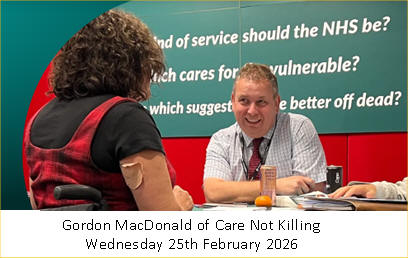
Gordon Macdonald of Care Not Killing. WEd 25 Feb 2026
 Dear Supporter
Our opponents claim that a change in the law is necessary to prevent dying patients from suffering. However, when laws change around the world, it is not the strong who must pay the price - it will be those who are the most VULNERABLE:
1. Those Who Feel a Burden
When people
begin to believe that their care is putting too much strain on relatives,
friends, caregivers or the NHS — “choice” to end one’s life can subtly
become an obligation to do so.
2. Those Whose Depression is Mistaken for Consent
Serious illness often triggers depression. If that despair goes
undetected, a temporary crisis can turn into a tragic DEATH, a wholly
avoidable outcome with correct diagnosis and treatment.
3. Those Given Wrong Prognoses
Doctors
are not fortune-tellers able to predict the future. People given months to
live sometimes survive for years with a good quality of life.
Consider celebrity assisted suicide campaigner Dame Esther Rantzen,
diagnosed with lung cancer in January 2023, rapidly advancing to stage 4,
and she “didn't expect to last until that Christmas.”
But three years
later, she is alive and active.
4. Those Missed by so-called “Safeguards”
Robust patient “safeguards” are wont to fail in large complex
organisations such as the NHS widely considered to be Europe’s biggest
employer - because of factors including:
Low visibility of abuse: Many
safeguarding issues occur obliquely, making them difficult to detect even
with training
Cognitive impairments (e.g., dementia) require higher levels of oversight, which may prove too costly or impractical to implement
Ineffective communication among healthcare teams, or between staff and patients/families, is a major cause of safeguarding failure
Overreliance on IT systems and technology, which is complicated and confusing to use, can limit access to patients’ electronic health records, leading to errors
5. Those at Risk of Suicide
Once
embedded in the medical system, assisted death changes the culture - going
from preserving life to routinely ending it.
In this type of environment, suicide is normalised, directly undermining suicide prevention efforts.
Given what’s at stake, it is valid to ask how much of the enthusiasm for medically assisted killing is driven by considerations which don’t arise from compassionate motives, but MONEY.
1. Denying Money
Palliative Care: funding is NOT
keeping up with demand
A Lancet Global Health study found that the number of people needing palliative care has increased by 74% over the past 30 years, reaching 73.5 million in 2021.
Dr Libby Sallnow of the Marie Curie Palliative Care Research Department at University College London noted that while life expectancy is increasing, healthy life expectancy is not improving at the same pace.
In other words, people are living longer, but often with more illness and prolonged suffering.
The World Health Organisation has warned that around 4.4 million people across its European region die each year needing palliative care. Cancer accounts for nearly 40% of cases, heart disease about one-third, dementia 16%, and chronic lung disease 6%.
The European Association for Palliative Care recommends at least two specialised palliative services per 100,000 people.However, Europe averages just 0.79 per 100,000, and more than half of European countries report limited resources.
Yet, Hospice UK warns that 40% of its 200-plus members will have to make cuts this year because government grants are not keeping pace with surging costs. In addition, almost two-thirds of independent hospices in England reported a deficit in 2023-24, according to the National Audit Office. Inflation combined with stagnant government funding means many hospices face potential closures or reduced bed capacity, with 16 hospices already reporting significant service cuts.
Hospice UK reported in 2023 that:
Adult hospices in
England had faced a real-terms cut in government funding of £47 million
over the past two years, meaning that funding has not kept pace with
rising costs
57% of hospices in England and Wales ended the last financial year in deficit, with 20% recording a deficit of over £1m Last year, the UK Government did provide an additional £100m for hospices. But this was capital funding only. It could be spent on infrastructure and equipment, but not every day running costs such as staff salaries, medicines, utility bills etc. The situation is particularly acute in England, where 12,000 terminally ill patients could lose access to end-of-life care.
King's College London reports that each year, approximately 100,000 dying people do not receive palliative care, leaving many in unnecessary pain and distress.
A further concern – if the law changes – is what would happen should a UK hospice refuse to kill a patient who requests an assisted death?
In Canada, the British Columbia government withdrew its $1.5m annual funding from the Delta Hospice Society (DHS) in 2021 — 94% of the 10-bed hospice’s operating costs — forcing it to close its doors after it had refused to allow MAID (Medical Assistance in Dying) killings on its premises. This is a warning for what’s in store for Britain if the Leadbeater and McArthur Bills pass.
2. Saving Money
Lord Falconer’s financial
consideration – "there's only so much money to go around" – very much
appears to apply here: The UK Government’s own Impact Assessment carried
out for the Department of Health and Social Care (DHSC) last year shows
that:
By year 10 of Leadbeater Bill implementation, NHS savings estimated between £5.84m and £59.6m per year by allowing assisted deaths were forecast. This figure includes savings on “hospice...care costs”, so UK hospices can expect future cuts in government grants should the Lead-beater Bill become law. Of course, the real amount is much larger because savings in welfare benefits that would have been awarded if deceased patients hadn’t opted for assisted suicide are excluded from the calculations.
Yet, paradoxically, the projected healthcare savings WON’T radically benefit other patients, as, in the bigger picture, tens of millions of pounds are negligible in the context of the £217 billion annual NHS spend.The most logical and caring solution would be to abandon the Leadbeater Bill.
3. Making money
A:
Financial coercion, especially of the elderly
During
scrutiny of the Leadbeater Bill in the Lords, concerns were raised that
terminally ill people could face financial coercion, including pressure
linked to inheritance.
Amendments tabled by Lord Hunt of Kings Heath, proposed:
An independent financial review, and Background checks on close relatives,So as ... to prevent assisted suicide where there was risk of financial abuse.
Elder abuse prevention charity Hourglass has warned of an “epidemic” of abuse, including cases driven by people wanting an older relative’s inheritance “now”.
Lord Falconer of Thoroton, the Bill’s main sponsor in the Lords, opposed making financial reviews mandatory for all applicants.
Earlier [in February] , he argued: If there is a specific suggestion of financial motivation, it should be investigated. But he was “strongly against routine checks” involving bodies such as HMRC or the Financial Conduct Authority for every applicant.
Flipping safeguarding on its head.
Lord Falconer says that he wants abuse cases “investigated”. However,
unless obvious red flags are noticed while the patient is still alive
(unlikely in most cases without routine checks for each application)
investigations could only occur RETROSPECTIVELY - after death. What’s
called for are preventative measures to safeguard the victim’s life while
still alive. Where the consequence is death, safeguards should strongly
err on the side of scrutiny rather than administrative convenience for
those managing the assisted suicide service.
Financial coercion is often subtle and concealed, making it extremely difficult to detect. The best solution, therefore, is NOT to legislate for assisted killing in the first place.
B: Commercial businesses: Funeral homes now authorised to
euthanise Canadians
Last week, Canadian podcaster Kelsi
Sheren posted a video on X of a two-minute phone conversation that she had
with a Vancouver funeral director. Here is the transcription:
Podcaster: Hi Rebecca, I was just
wanting to inquire about something really quick. I know it's close to
closing time for you, but do you have a second? So I was just um, I heard
that this was an option and I just wanted to know because it sounds kind
of crazy to me, so just bear with me. Are you guys able to provide MAID at
your funeral home location?
Funeral
Directors: “We are, yeah. And just for context, could I ask
your first name?”
Podcaster:
”Kelsey.”
Funeral Directors:
“Hi Kelsey, I'm Rebecca. So yes, we do offer our gathering room space for
MAID provisions and that is whether, that is regardless of whether the
person chooses to use us as the funeral home following the provision. So
we can either do a rental of this space, and then that person is taken
care of by another funeral home following that provision [of euthanasia].
Or if they would like to work with us throughout all of their care,
they can receive [euthanasia] provision here and then their body would
actually remain on site to be cared for.
Podcaster: “Do you guys, do you have
a cost breakdown of what that looks like?”
Funeral Directors: “Yeah, so in
general, the cost for using, let me just get my form here. So, the cost
for using our gathering room for a MAID provision is $495. Okay.
Podcaster “And that is the cost if
they are not also using us as the funeral home of choice.”
Funeral
Directors: If they were using us as the funeral home as well, we can
offer that same space for $300.
[YES: You get a $195 DISCOUNT on
your death if you also use the home’s funeral services]
Podcaster: “Okay, perfect. Okay,
well, thank you. I was just curious.
I wanted to do some research on
the funeral homes in the area that were providing that.
I just wasn't
sure. I heard you were doing it, but I wasn't sure.”
Funeral Director: “Yeah, it's a good
option for people who don't feel comfortable either at home or at a
hospital There's not too many third-party locations. So that's why we
offer that.”
Podcaster:
“Perfect. Well, thank you so much for your time today. I appreciate it.”
Funeral Director: “All right, you
take care.”
Podcaster: You
too. Bye bye.
CALL ENDS
Podcaster
(to her audience): “You hear that? They're killing people in funeral
homes. Have a good day guys.”
It turns out that the funeral home Kelsi spoke to is the same one that carried out the killing just after Christmas of 26-year-old KEANO VAFAYAN - the Canadian man who was euthanised because he was diabetic, had seasonal depression and was blind (but not dying or in physical pain).
Sadly, money is playing too big a part in the push by our opponents to get assisted killing placed on the statute books in Britain.
Our support base has grown significantly in the last few years.
This is helping to narrow the financial gap between us and Dignity in Dying (formerly the Voluntary Euthanasia Society), and I am incredibly grateful to every one of you for that.
Yet Dignity in Dying’s latest audited accounts show that they spent £3.38M in 2024 to change the law (roughly x10 times our combined annual revenue)
Around a THIRD of their income (£928,788 in 2024) comes from ‘High Value Donors’.
The biggest is the Bernard Lewis Charitable Trust (River Island Clothing)
A recent investigation into DID’s funding by the political news website Canary reveals that, since 2017:
The Lewis family trust has given £1.2 million to Dignity in Dying and its sister charity, Compassion in Dying
Bernard Lewis is also funding a staff member for Lord Falconer. Dignity in Dying are paying for the printing of literature on the Leadbeater/ Falconer assisted suicide bill
The challenge facing us is Dignity in Dying’s (DiD) spending power.
We are not in the same league as DiD when it comes to wealthy corporate donors.
The vast majority of our income comes from the thousands of caring individuals like you who respond so generously to email fundraising campaigns like this one.
When laws change, culture changes.
I have suggested
how big a role MONEY plays in the considerations of some who welcome
assisted suicide and euthanasia laws.
Ultimately, should the law change, frail, elderly, disabled the
isolated people will pay the ‘highest price’.
Your continued support
will make a material difference to our multiple campaigns across the
country as we prepare to keep up the pressure on deadly legislation over
the next crucial weeks.
Yours sincerely,
Gordon Macdonald- CEO, Care Not Killing
Please support Care not Killing.
The campaign
against euthanasia is not over.
Care not Killing need your continued
support.