


Catholic Medical Quarterly Vol 76 (2) May 2026
Decriminalisation of abortion in the UK: A survey among doctors.
Dr Dermot Kearney Consultant Cardiologist
Background
 Contrary to popular belief, abortion remains a criminal offence in the
UK, subject to the 1861 Offences Against the Person Act.
Contrary to popular belief, abortion remains a criminal offence in the
UK, subject to the 1861 Offences Against the Person Act.
Offences against the Person Act 1861 (relevant sections 58 and 59)
58 Administering drugs or using instruments to procure abortion.
Every woman, being with child, who, with intent to procure her own miscarriage, shall unlawfully administer to herself any poison or other noxious thing, or shall unlawfully use any instrument or other means whatsoever with the like intent, and whosoever, with intent to procure the miscarriage of any woman, whether she be or be not with child, shall unlawfully administer to her or cause to be taken by her any poison or other noxious thing, or shall unlawfully use any instrument or other means whatsoever with the like intent, shall be guilty of felony, and being convicted thereof shall be liable to be kept in penal servitude for life.
59 Procuring drugs, &c. to cause abortion.
Whosoever shall unlawfully supply or procure any poison or other noxious thing, or any instrument or thing whatsoever, knowing that the same is intended to be unlawfully used or employed with intent to procure the miscarriage of any woman, whether she be or be not with child, shall be guilty of a misdemeanour, and being convicted thereof shall be liable to be kept in penal servitude.
The Abortion Act of 1967 modified the law, allowing abortions to be carried out without prosecution if the stipulations of the Act were correctly followed. Abortion, however, remains a crime on the statute books.
There is currently a movement, led by pro-abortion lobbyists, to decriminalise abortion so that it might be considered a simple healthcare issue, available for any reason up to birth and regulated by healthcare professionals. In June 2025, a step towards the eventual total decriminalisation of abortion was achieved with a decisive vote in the House of Commons on the question of the prosecution of mothers for any involvement in ending their own pregnancies.[1] An amendment to the Crime and Policing Bill, known as clause 191, proposed by Labour MP Tonia Antoniazzi, was passed by a majority of 242 votes (379 in favour, 137 against). The Bill, including the Antoniazzi amendment, is currently being debated in the House of Lords. If passed and confirmed with Royal Assent it would mean that no woman in England and Wales could face prosecution for any involvement in intentionally procuring an abortion, even up to the moment of birth. The law would not permit total decriminalisation, however, as others assisting in the procurement of abortion or actually performing an abortion could still face prosecution if it could be proven that an abortion was procured outside of the terms of the Abortion Act.
There are differences of opinion among doctors on the ethical question of abortion. Organisations such as the Royal College of Obstetricians and Gynaecologists and the British Medical Association have published position statements in support of total decriminalisation of abortion,[2,3] although no ballot has ever taken place to actually ascertain the true opinions of the members of these organisations. This paper provides useful information on the opinions of doctors in the UK regarding the issue of decriminalisation of abortion.
Aims of study
- To ascertain the level of understanding among doctors in the UK of the laws regarding abortion and the level of perceived support for the decriminalisation of abortion.
- To promote discussion of these issues, as most doctors in the UK rarely have opportunities to hear pro-life arguments. Rational debate is largely suppressed.
Methods
Over a 6 week period in June-July 2019, 110 doctors from a wide range of clinical specialities were surveyed. Three other individuals declined the offer to participate in the study
All participants were employed in a single large teaching hospital in the North-East of England and they represented 46% of the total number of medical doctors employed in that institution.
Selection of participants was random and consisted of opportunistic and casual face to face chance encounters on hospital wards, in the hospital cafeteria and at Grand Rounds meetings. Care was taken to ensure that clinical duties were not interrupted.
All participants anonymously completed a single A4 sheet questionnaire containing the substantial questions “In your opinion, should abortion be decriminalised?” and “Why?” (or “Why not?”). After completing the questionnaire, participants were then asked “Without revealing what your responses were, if the question had been ‘In your opinion, should abortion be allowed for any reason, without restriction, up to birth?’, would that have changed your response?”
57% of randomly-selected participants (63 individuals from the total cohort of 110) were also asked an additional preliminary question “In your opinion, when does human life begin?” to ascertain if this additional question might influence how the substantial question was answered. A previous survey in 2016 had addressed that very question on when human life begins.[4]
Anonymity was protected but each participant provided non-identifiable demographic details relating to their sex, age-group, whether they had a Faith / Religion or not and whether or not they were a parent. It was felt that these factors might influence participants’ responses [Table 1].
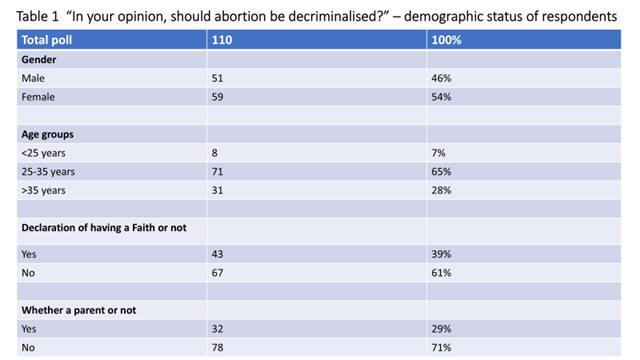
Statistical analysis testing significance of demographic response variation was performed using Pearson’s chi-squared test.
Results
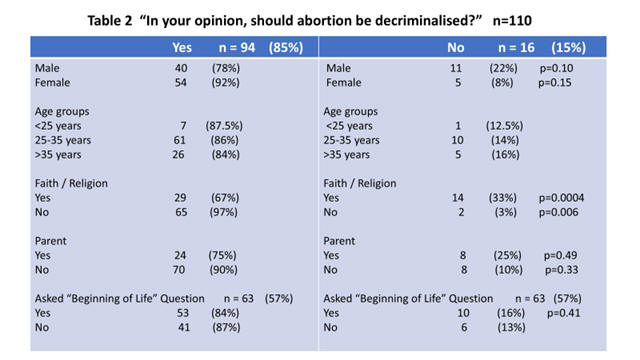
The results of the survey are summarised in Figure 1 and in Table 2.
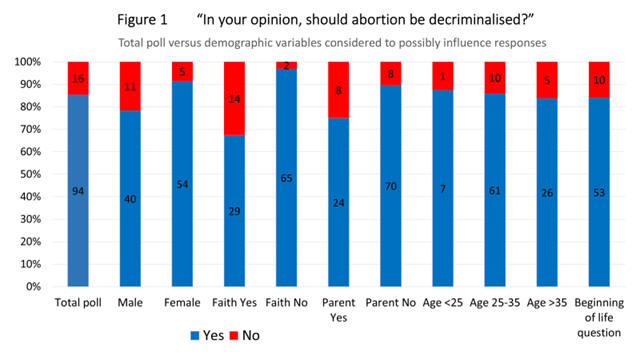
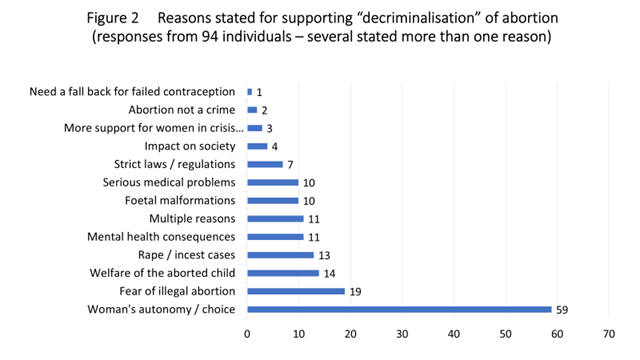
A large majority (85%) stated that abortion should be decriminalised. The reasons stated for supporting this position were very varied [Figure 2]. Many individuals gave several reasons.
Whether or not respondents had a religious belief and, to a lesser extent, gender status had the most significant influence on responses. Asking the preliminary question regarding when human life begins did not have any significant impact on responses to the substantial question regarding decriminalisation (p=0.41).
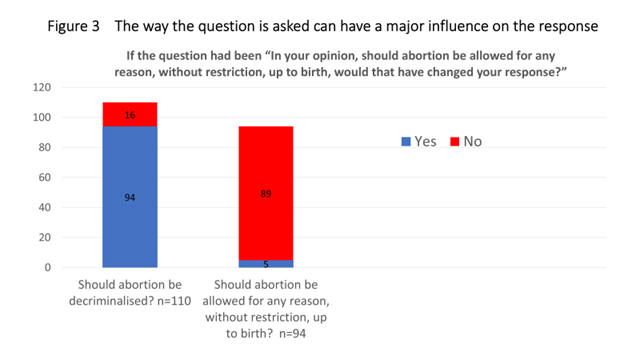
The result relating to asking the question in a different way is summarised in Figure 3 with direct comparison made to responses received from the substantial question. While 85% of respondents stated that they supported “decriminalisation” of abortion, only 5% of these supported unrestricted access to abortion, for any reason, up to birth.
The additional question relating to when human life begins drew a variety of responses, as was the case in 2016, and these are listed in Table 3. Responses were broadly similar to those obtained in the previous 2016 survey.
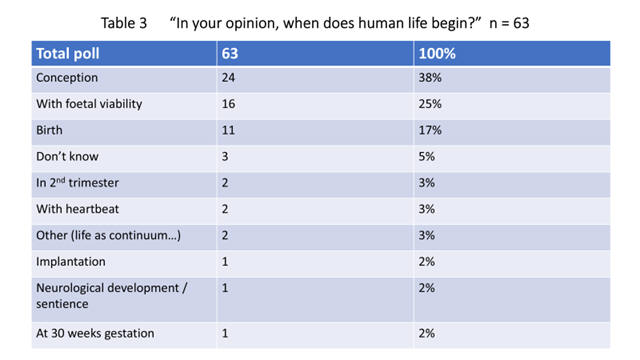
None of the participants in 2016 participated in this current study. Once again, the most popular response to this question was the opinion that a human life begins at the time of fertilisation (or conception) but this scientifically-proven answer was only believed by 38%, meaning 62% of doctors in this survey hold a belief contrary to the scientific reality of when a human life begins.
Discussion
While a clear majority of respondents in this survey supported what they considered to be a principle of decriminalisation of abortion, when the reasons for this support were examined it was clear that the majority supporting “decriminalisation” did not actually fully understand the issue in question. All of the reasons given in support of decriminalising abortion are already provided for by current interpretation of UK law. This includes the most common reason stated, supporting a woman’s autonomy or “right to choose”. Of the 277,970 abortions allegedly carried out in England and Wales in 2023, 98% were, in essence, performed for that very reason.
If abortion is “decriminalised” in the UK, by a formal Act of Parliament, regulation will be handed over to the medical profession and most likely to the Royal College of Obstetricians & Gynaecologists (RCOG). The current leadership of the RCOG has repeatedly called for abortion to be regulated like any other healthcare service. A recent President of the College has stated that it should be no different from other medical procedures such as having “your bunions sorted”.[5] In the regulatory hands of the RCOG, it is likely that abortion provision would become even more liberal than at present.
With total “decriminalisation”, pressure could be brought to bear on healthcare professionals with conscientious objection to participating in abortion. Conscience is currently protected by law, under a feature of the Abortion Act. If the Abortion Act no longer applies, this protection could be compromised.
Perhaps the most interesting result to emerge from this survey relates to the issue of asking the substantial question in a different way. While generally supportive of abortion provision, the results of this survey suggest that the vast majority of doctors do not support unrestricted access to abortion up to birth. This could be an important factor to highlight in future parliamentary debates and in media discussions.
Study limitations
This was a small study confined to one geographical region and one healthcare institution. The participant population may not be representative of doctors in the UK as a whole.
It was initially intended to include medical students in the study cohort. Their absence from the cohort meant that a low number of participants under 25 years of age were included.
The over 35 year age group is also under-represented. This was related to the randomised nature of the study population selection and the lower likelihood of chance encounters with senior clinicians outside of specific clinical areas.
Conclusions
Support for abortion is strong and deeply ingrained among doctors in the UK. The vast majority of doctors in the UK have a poor understanding of what abortion law actually entails and an equally poor understanding of what “decriminalisation” of abortion would mean.
The majority of doctors claiming to support “decriminalisation” also believe that some restrictions to abortion access are necessary. There is little support among UK doctors for unrestricted access to abortion.
Pro-life groups in the UK face tremendous challenges in attempting to convince doctors and the general public of the humanity of the pre-born and the reality of abortion. Creativity, perseverance and faith are required. This type of survey facilitates opportunities to promote prolife ideas among physician colleagues.
References
- MPs vote to decriminalise abortion for women in England and Wales. https://www.bbc.co.uk/news/articles/c2le12114j9o
- The removal of criminal sanctions for abortion: BMA Position Paper https://www.bma.org.uk/media/ukcjyayh/removal-of-criminal-sanctions-for-abortion-position-paper-updated-2025.pdf
- Reforming Abortion Law. RCOG position statement. https://www.rcog.org.uk/about-us/campaigning-andopinions/position-statements/reforming-abortion-law/
- Kearney D. The Beginning of Life: UK report - A survey among doctors & medical students. Catholic Medical Quarterly, Volume 67(1) February 2017.
- Daily Mail Interview with Professor Lesley Regan, 16th September 2017.